
Concrete Cracking in SA: Causes and Prevention Guide
Concrete’s Silent Language of Stress
Concrete rarely fails loudly. Instead, it speaks in fine lines, hairline fractures, and subtle surface splits that slowly map out the stresses it has endured. In South Africa, where blazing summers, sharp coastal humidity shifts, highveld temperature swings, and variable workmanship standards all collide, concrete cracking is not an exception. It is an expectation that must be managed.
Cracking does not always signal failure. But it always signals imbalance. Somewhere between design, materials, placement, and environment, the concrete has been pushed beyond what it can comfortably carry. Understanding why this happens is the first step in preventing it.
Why Concrete Cracks in South African Conditions
Concrete is a composite material with excellent compressive strength but limited tensile capacity. That imbalance alone makes it vulnerable. But in South Africa, environmental stress amplifies the issue.
High daytime heat followed by rapid evening cooling in inland provinces creates repeated thermal cycling. Coastal regions introduce salt-laden moisture that accelerates reinforcement corrosion. Meanwhile, seasonal rainfall patterns affect curing consistency on active sites.
Cracking typically emerges from a combination of:
- Moisture loss during early curing
- Temperature-driven expansion and contraction
- Restraint from reinforcement or subgrade
- Poor mix design or excess water content
- Inconsistent site curing practices
In essence, concrete does not crack because of a single flaw. It cracks because multiple small stresses align at the wrong moment.
The Role of Curing in Crack Prevention
Curing is often treated as an afterthought on fast-moving South African construction sites, yet it is the most critical phase in determining long-term durability.
When concrete is poured, hydration begins immediately. This chemical reaction generates heat and requires sustained moisture. If water evaporates too quickly due to wind, sun, or low humidity, the surface shrinks while the core remains unstable.
This mismatch creates tensile stress that manifests as cracking.
In South Africa, the risk is intensified by:
- Strong inland winds during dry seasons
- High UV exposure accelerating surface evaporation
- Sudden rain events interrupting curing cycles
- Limited curing protection on smaller residential sites
Proper curing techniques include continuous water curing, curing compounds, and physical coverings such as hessian sheeting. The aim is simple: keep moisture locked in long enough for hydration to complete evenly.
When curing is neglected, concrete does not develop as a unified mass. It develops as a stressed shell over an unstable interior.
Mix Design: The Hidden Architecture of Strength
Every durable concrete structure begins before the pour, inside the mix design. In South African construction, variability in aggregate quality, batching control, and water addition on-site can significantly influence cracking potential.
A common issue is the temptation to “improve workability” by adding extra water. While this makes placement easier, it increases porosity and reduces final strength. More importantly, it increases shrinkage during drying.
Key mix-related contributors to cracking include:
- Excess water-to-cement ratio
- Poor aggregate grading
- Inconsistent batching or hand mixing
- Lack of admixtures for climate control
Well-designed mixes reduce internal voids and limit shrinkage potential. In modern practice, plasticisers and shrinkage-reducing admixtures are increasingly used to improve flow without compromising strength.
In South African conditions, especially for exposed slabs and external works, a carefully controlled mix is not optional. It is structural insurance.
Thermal Expansion and Contraction Stress
Concrete behaves like a slow-moving thermal organism. It expands under heat and contracts under cooling. In a stable environment, these movements are manageable. In South Africa’s climate extremes, they become a primary cracking driver.
In regions such as Gauteng, surface temperatures can swing dramatically between day and night. This causes the outer layer of concrete to expand and contract faster than the core. The resulting differential movement creates internal stress.
When that stress exceeds tensile capacity, cracks form.
Thermal cracking is especially common in:
- Large slabs exposed to direct sun
- Mass concrete foundations
- Bridge decks and retaining structures
- Industrial floors with minimal shading
If the structure is restrained by reinforcement, subgrade friction, or adjoining elements, the stress has no escape path. It releases through cracking.
Control joints, shading during curing, and temperature-aware scheduling are essential tools to reduce this risk.
Plastic Shrinkage Cracking in Hot and Windy Sites
One of the most common early-stage defects in South African construction is plastic shrinkage cracking. These cracks form within hours of placement, while the concrete is still in a plastic state.
They are typically caused by rapid surface moisture loss. Hot sun, dry air, and wind combine to evaporate water faster than it can rise within the mix.
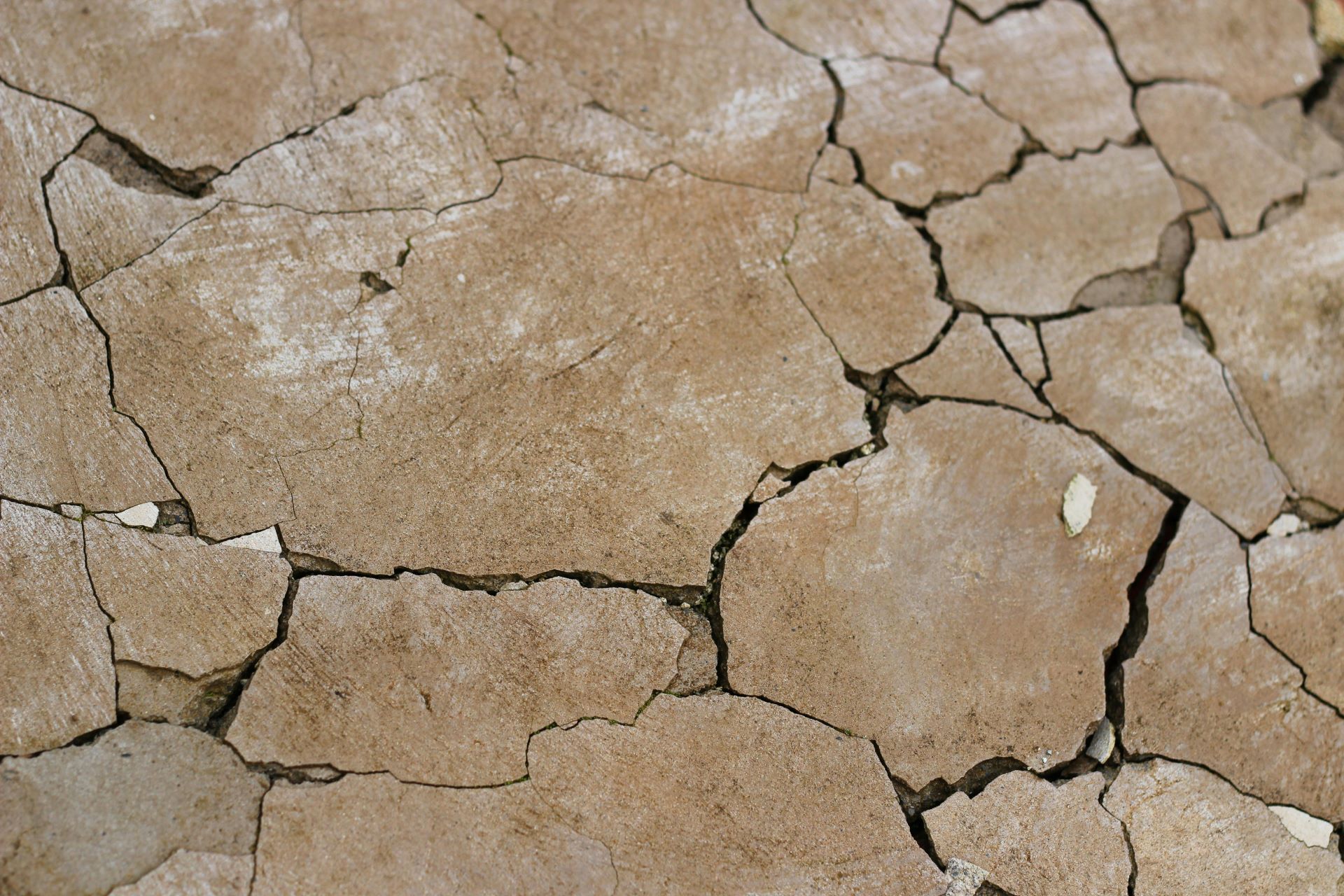
The surface contracts while the underlying material remains fluid. The result is a network of shallow cracks that can resemble crazing or map patterns.
This is particularly prevalent in:
- Open construction sites without wind protection
- Summer pours in inland provinces
- Thin slabs with high surface area exposure
Preventing this requires immediate action after placement. Delayed curing is often too late. Evaporation control must begin as soon as finishing is complete.
Structural Restraint and Movement Limitations
Concrete prefers to move freely as it cures and adjusts. However, in real construction systems, it is almost always restrained.
Reinforcement steel, foundation friction, adjacent structural elements, and embedded fixtures all limit movement. This restraint transforms natural expansion or shrinkage into internal stress.
When stress builds faster than the material can relieve it, cracking becomes the release mechanism.
In South African residential and commercial builds, restraint-related cracking often appears:
- Around columns and load-bearing edges
- At slab-wall junctions
- Near pipe penetrations and service ducts
- Along long uninterrupted slab spans
Proper detailing, including joint placement and reinforcement layout, helps distribute stress more evenly and prevent concentrated failure zones.
The Influence of Subgrade Preparation
A well-designed concrete mix can still fail if placed on poor ground. Subgrade preparation plays a major role in crack prevention.
In South Africa, variable soil conditions ranging from expansive clay to loose sandy fills create unpredictable support conditions. When the subgrade settles unevenly, the slab above is forced to bend and crack.
Common subgrade-related issues include:
- Inadequate compaction
- Moisture variation in underlying soil
- Organic material left in fill layers
- Differential settlement across large slabs
Proper compaction, moisture conditioning, and soil stabilization are essential to create a uniform support platform.
Without it, even the strongest concrete behaves like a sheet of glass over shifting ground.
Construction Practices That Influence Cracking
Beyond design and materials, workmanship plays a decisive role in crack formation. Many cracks observed in South African structures are not material failures but process failures.
Key site-related contributors include:
- Adding water to concrete on-site
- Delayed placement leading to partial setting
- Poor vibration or compaction
- Inadequate joint cutting or omission
- Premature finishing while bleed water is present
These practices disrupt internal structure formation and create weak planes where cracks later develop.
Construction discipline during the first few hours of placement often determines decades of performance.
Preventive Strategies for Long-Term Durability
Preventing concrete cracking is not about eliminating all stress. It is about controlling where and how stress is released.
Effective strategies include:
- Early and continuous curing immediately after finishing
- Controlled mix design suited to local climate conditions
- Strategic placement of control and expansion joints
- Proper subgrade compaction and moisture conditioning
- Use of admixtures to reduce shrinkage and improve workability
- Avoidance of excessive on-site water addition
Each layer of prevention reduces cumulative stress, making cracking less likely and more predictable when it does occur.
Understanding Crack Behaviour Rather Than Fear
Not all cracks indicate structural danger. Many are surface-level responses to shrinkage or thermal movement. The key is understanding progression.
Stable, non-growing hairline cracks often remain cosmetic. Active widening cracks, especially those accompanied by displacement or moisture ingress, require professional evaluation.
In South African construction environments, where climate stress is constant, a certain level of cracking is part of the material’s natural behaviour. The objective is not perfection. It is controlled performance.
Concrete in South Africa exists in a demanding dialogue with its environment. Heat, moisture, soil variability, and construction speed all influence its behaviour long after placement.
Cracking is not an anomaly. It is a response. A message written into stone.
When curing is respected, when mix design is disciplined, and when thermal and structural movement is anticipated, that message becomes faint, controlled, and non-threatening.
In the end, durable concrete is not born from resistance to nature, but from cooperation with it.