Climate Zones and Building Lifespan in South Africa
How South Africa’s Climate Zones Affect Building Lifespan
Climate as the Silent Architect of Decay
Across South Africa, buildings are never truly static structures. They are living responses to heat, moisture, salt, wind, and aridity, all of which collaborate quietly to determine how long a structure remains sound.
From the salt-heavy air of Durban’s coastline to the dry, UV-intense expanses of the Karoo, environmental exposure shapes degradation patterns in ways that are both predictable and deeply regional. Studies of atmospheric corrosivity in South Africa show that even inland industrial zones can experience corrosion rates rivaling coastal environments due to pollution and humidity shifts, while true inland rural areas often enjoy significantly slower degradation cycles.
This article explores how South Africa’s three dominant construction environments—coastal, inland, and semi-arid—affect building lifespan, and how material choices and maintenance strategies must evolve accordingly.
South Africa’s Climate Framework and Structural Exposure
South Africa’s building sector climate classification is typically divided into six zones, ranging from cold interior to sub-tropical coastal and arid inland regions. These zones are defined by temperature ranges, humidity levels, and condensation risk, all of which directly influence structural durability and maintenance demands.
However, in practice, construction performance is often simplified into three dominant exposure categories:
- Coastal high-corrosion environments
- Inland mixed-industrial and temperate environments
- Semi-arid low-humidity UV-intense environments
Each of these behaves like a different kind of slow weathering engine, grinding down materials at different speeds and in different ways.
Coastal Zones: The Accelerated Corrosion Frontier
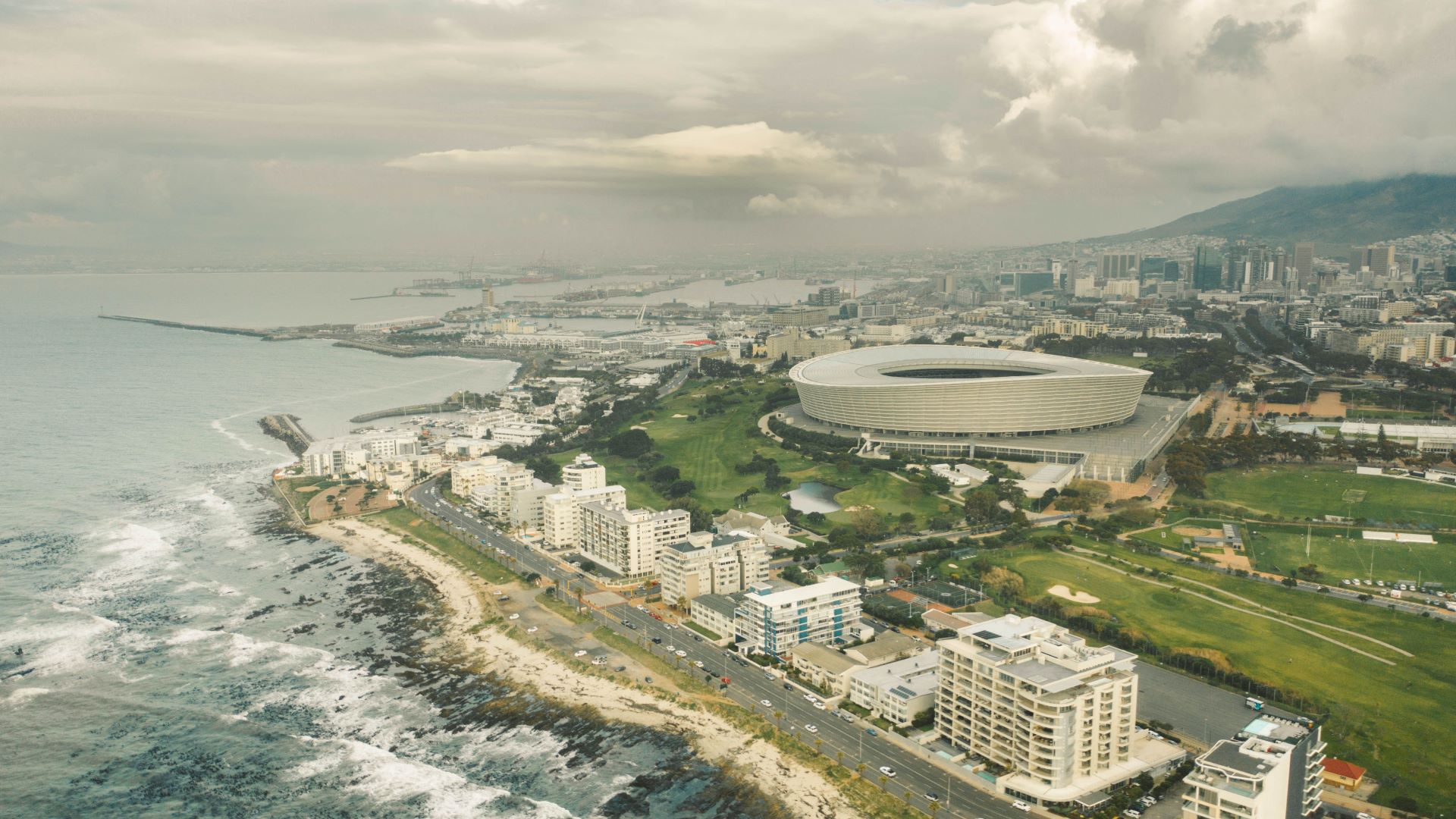
Coastal regions such as Durban, Cape Town, Gqeberha, and Richards Bay represent the most aggressive atmospheric environments in the country. Here, buildings are constantly exposed to salt-laden air, high humidity, and strong wind-driven moisture cycles.
Salt particles suspended in the air settle on steel, concrete, and façade systems. Once moisture is introduced, chloride ions penetrate protective coatings and begin electrochemical corrosion processes. In reinforced concrete, this can lead to steel expansion inside the structure, causing cracking and spalling over time.
Steel elements such as roof sheeting, balustrades, bolts, and exposed frames degrade faster because corrosion is not a slow, uniform film. It becomes a pitting process, creating localized structural weaknesses that are often invisible until failure approaches.
Maintenance in these zones is not optional. It becomes part of the building’s operational rhythm.
The most significant coastal degradation patterns include:
- Accelerated oxidation of structural steel and fixings
- Coating breakdown under UV and salt spray interaction
- Moisture entrapment in joints and façade cavities
- Concrete reinforcement corrosion from chloride ingress
- Faster fatigue of seals, gaskets, and expansion joints
Even proximity matters. Research and field observations indicate that coastal corrosion intensity can extend several kilometres inland depending on wind and topography, meaning “near-coastal” developments often behave like full coastal environments rather than transitional ones.
Inland Zones: Industrial Complexity and Variable Decay
Inland South Africa is often assumed to be a low-corrosion environment, but this is only partially true. Inland degradation patterns are highly variable, influenced by industrial pollution, altitude, humidity cycles, and temperature fluctuation.
Johannesburg, Pretoria, and industrial hubs such as Germiston and Sasolburg demonstrate that inland corrosion can reach unexpectedly high levels due to atmospheric pollutants and moisture retention cycles. In fact, measured corrosion rates in certain inland industrial zones can approach coastal levels, challenging the assumption that distance from the sea guarantees durability benefits.
Unlike coastal environments, inland degradation is less uniform and more cyclical. Buildings experience thermal expansion and contraction due to wide daily temperature swings. This movement stresses joints, fasteners, and coatings, creating micro-cracks that gradually widen over time.
In inland zones, deterioration typically manifests as:
- Coating fatigue due to thermal cycling
- Joint failure in expansion interfaces
- Pollution-driven surface corrosion in industrial areas
- Moisture retention in shaded structural zones
- Gradual fading and UV wear on exposed façades
The inland environment behaves less like a constant corrosive force and more like a repetitive stress test, where materials fail through accumulated micro-damage rather than rapid oxidation.
Semi-Arid Zones: UV Dominance and Material Drying Stress
Semi-arid regions such as the Northern Cape and parts of the Free State introduce a different type of structural challenge. Here, moisture is limited, but environmental intensity is high.
UV radiation becomes one of the most destructive forces acting on buildings. Paint systems, sealants, plastics, and roofing membranes degrade rapidly under prolonged solar exposure. Unlike coastal environments where corrosion dominates, semi-arid environments attack polymer stability and surface coatings.
Thermal amplitude is also extreme. Daytime heat can be intense, while nighttime cooling is rapid. This constant expansion and contraction cycle places stress on masonry, concrete, and joint systems.
Common degradation patterns in semi-arid regions include:
- UV-driven breakdown of paint and sealants
- Surface embrittlement of plastics and rubber components
- Cracking in plaster and masonry due to thermal cycling
- Dust abrasion on exposed surfaces
- Reduced lifespan of waterproofing membranes
Interestingly, while corrosion is lower due to reduced humidity, maintenance demands remain high. The absence of moisture does not equal structural stability. Instead, the stress shifts from chemical degradation to physical and thermal fatigue.
Material Performance Across Climate Zones
Material selection in South African construction must always account for environmental exposure, yet the same material behaves differently depending on location.
Steel, for instance, is highly vulnerable in coastal environments without protective coatings, while performing significantly better inland if properly maintained. Concrete durability also varies depending on chloride exposure and thermal cycling, with coastal reinforcement corrosion being a primary failure mode.
Aluminium and stainless steel are often preferred in coastal applications due to their resistance to chloride-induced corrosion, while inland environments allow for broader material flexibility. Semi-arid regions, however, require UV-stable coatings and expansion-tolerant systems rather than corrosion resistance alone.
The key insight is that no material has a universal performance profile. Longevity is not inherent to the material itself but to the compatibility between material and environment.
Maintenance Cycles: The Real Determinant of Lifespan
Across all three climate zones, maintenance frequency becomes the hidden variable that determines building lifespan more than initial construction quality.
Coastal buildings often require frequent inspections, coating reapplication, and corrosion monitoring. Inland buildings demand periodic structural and joint inspections due to thermal stress accumulation. Semi-arid buildings rely heavily on sealing integrity and UV protection renewal.
Where maintenance is neglected, even high-quality materials degrade rapidly. Where maintenance is consistent, even moderately specified materials can outperform expectations.
The difference between a 20-year building and a 60-year building is often not found in design drawings, but in maintenance schedules.
Design Adaptation Strategies by Region
Successful South African construction increasingly relies on climate-responsive design rather than uniform specification.
Coastal adaptation typically includes corrosion-resistant metals, elevated detailing to reduce moisture pooling, and protective coating systems designed for chloride exposure.
Inland adaptation focuses on accommodating thermal movement, improving ventilation to reduce moisture accumulation, and selecting coatings that resist industrial pollutants.
Semi-arid adaptation prioritises UV-resistant finishes, flexible joint systems, and materials capable of withstanding extreme temperature variation without embrittlement.
These adaptations are not luxury upgrades. They are essential recalibrations of structural expectation based on environmental reality.
The Role of Microclimates and Localised Risk
Beyond broad climate zones, microclimates can significantly alter building performance. Proximity to industrial emissions, elevation, wind direction, and shading can all intensify or reduce degradation rates within the same city block.
For example, sheltered surfaces may accumulate pollutants more heavily, while exposed surfaces may self-clean through rainfall or wind action. This variability means that two identical buildings can age at entirely different rates depending on placement and orientation.
Climate as a Lifespan Equation
South Africa’s construction landscape is defined not by a single environmental condition, but by a spectrum of climatic forces that continuously reshape building longevity.
Coastal zones accelerate chemical corrosion, inland zones amplify mechanical and industrial stress, and semi-arid zones intensify UV and thermal degradation. Each environment writes its own signature onto materials over time.
Understanding these differences is not just a matter of engineering precision. It is the foundation of sustainable construction practice in a country where climate is not background noise, but the primary force shaping architectural survival.
The true measure of a building’s lifespan is not how it is built, but where it is built—and how well that reality is understood from the very first design decision.